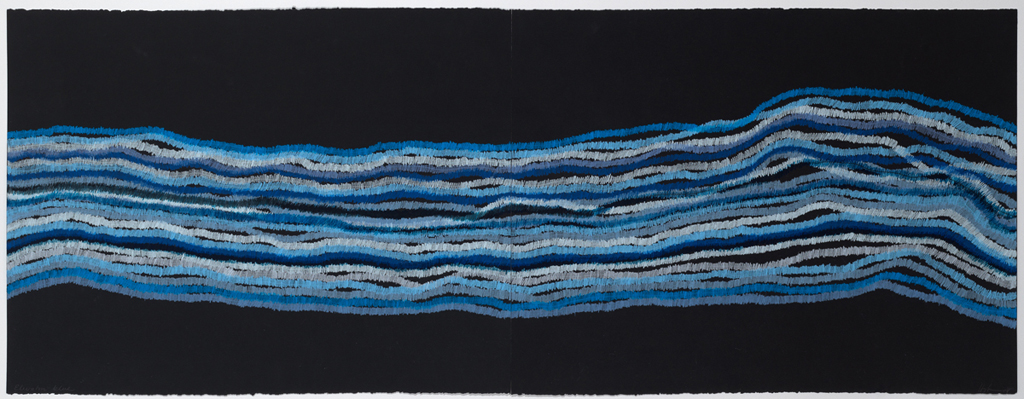
Life poses many choices. I gotta pick something every now and again. Hopefully, the choice I make is the best one for the moment. Monday, November 28, 2022
Is the Picture Big Enough?
Life poses many choices. I gotta pick something every now and again. Hopefully, the choice I make is the best one for the moment. Tuesday, September 13, 2022
Savoring, Republished from 2010

Saturday, April 2, 2022
Strict Beauty: Sol LeWitt Prints Out His Vision
Viewers must be visually cautious in approaching the art, no matter in what form, of Sol LeWitt as if it were for the first time, without preconceptions. The breadth of his work seemingly has no bounds. The work gives the impression of being restrained and constricted by rules yet the human element penetrates it with grace, boldness and tenderness. LeWitt knew this. The necessary parameters are always stated and evident but he created them with potentially unexpected results in mind. His story is told by drawn lines; strong, steady or wavering brushstrokes; and by the choices he made determining geometric design strategies in series of multiples, (even as pertains to his three-dimensional work).
From the very beginning, LeWitt was fashioning his hand to make delicate and expressive strokes as demonstrated in the first lithographs and etchings dating from as early as 1948. Correlating the similarities between the first few prints in the exhibition and those that become identified with his signature language points to his awareness of the surface area on which an image would rest.
One of LeWitt’s many purposes was to map the surface in shaping any of his two-dimensional work. Throughout his history, he laid out the ways in which he would do that. In every level of engagement though, he allowed himself ways to move further. His vocabulary grew. His language evolved multi-directionally. Lines were the predominate informants. The lines started to form shapes; the shapes became filled with color. The number of choices he could make grew, as he developed layers and layers of givens which he could move around any way he wanted to without sacrificing the consistency of imagery. Printmaking no doubt gave him a range of subtleties that were unachievable in original work because he could move entire images that lived on plates and reincorporate them into the print which he was making or repeat images without the direct introduction of his hand.
The magnificent array of prints in Strict Beauty demonstrates a means with which LeWitt could magnify the richness of possibilities within a surface of paper. Because he was his own kind of perfectionist, nearly all of the prints appear as though they are original drawings. That is one reason that they are stunning, arresting and embracing, defying all attachment to a mechanized method of production.
LeWitt’s specific types of imagery appear and reappear but from different perspectives, with different nuances, in different colors, with different kinds of lines. Isometric geometry often forms the skeleton for the application of color or line or both.
Fine lines become opaque brushstrokes, elegantly sweeping across the page over and over again in a sensical way, e.g. Parallel Curves, Wavy Lines, or in freeform combination of strokes, i.e. loops and curves, the fun-filled Loopy-Doopy; or move vertically in simple downward and upward strokes, overlapping, mixing with each other transparently in a gauzy curtain with an imaginary breeze wafting through.
The expansion of surface takes place also with his use of color, persistently primary and secondary and combinations thereof, sometimes so muted it almost disappears and is visible only in contrast to another color or to black, and sometimes so brash and loud that the viewer can only approach the piece from a certain distance in order to absorb it, i.e. The Lincoln Center Print, 1998.
Whirls and Twirls, Color, and Black, 2005, were made two years before LeWitt passed away. They are a magnificent journey of primary color, geometry and free flowing guided lines all contained within one fundamentally curvilinear shape. These pieces were double-hung as the conclusion of the exhibit. They express the unceasing dynamic that energizes LeWitt’s work.
Art grows from innumerable sources. Those sources are instilled in an active artist’s creative being and stem from life experience, education, consciousness and basic knowhow. The results of an artist’s process are seldom as definably pristine as the way in which LeWitt’s unfolds. But indefatigable analysis from outside of an artist’s work that apparently invites it squeezes out any chance of its being appreciated for its essence which is to be beautiful, thoroughly beautiful.
Illustrations from top to bottom: Untitled (Female Nude), 1950, lithograph, sheet size 15 7/8" x 11 9/16"; detail from a set of six Line Etchings, etching, color etching and aquatint, 2000, each sheet size 16"x 16"; Straight Brushstrokes in Five Colors in All Directions, 1996, color aquatint, sheet size 29" x 29"; Six Brushstrokes in Different Colors in Two Directions, 1993, color sugar lift aquatint, each sheet and image size 47" x 29 3/8"; Lincoln Center Print, 1998, screenprint, sheet size 38" x 30 1/4"; Whirls and Twirls, Color and Black, 2005, color linocut, each sheet size 25" x 55."
(This article was written after seeing Strict Beauty: Sol LeWitt Prints, curated by David Areford, PhD, at the Williams College Museum of Art, Williamstown, MA. The exhibit was installed first at the New Britain Museum of American Art, New Britain, CT, where LeWitt’s work was first exhibited in 1949.)
Monday, April 29, 2019
As Seen on Arteidolia: Swifts & Slows, Lyn Horton & Power Boothe
s w i f t s & s l o w s: a quarterly of crisscrossings
Line by Line
Lyn Horton & Power Boothe
None of us can remember seeing our hands and feet for the first time. We began to unfold the layers of knowing, differentiating this from that. Extending our hands and feet had a purpose. The initial steps to communicating. Our interaction with the world became too complicated to let communication remain as single hand outlines painted on pitted dark cave walls. Language needed some kind of organizing principle in order to mean anything. Left to right. Right to left. Up and down. Down and up. Across. How to assemble symbols to declare, to instruct, to explain, to question, to exclaim, to simply say.
Somewhere in that evolution the grid appeared. Some say it is the way our brain is arranged. How to extend order to our internal and external cognitive environments.
Originally these grids were only dots and called “Ellipsis” as in dot dot dot. Dots then became lines. “Ellipsis” stayed. “Ellipsis” pointed to: More planes to denote. More spatial relationships to create.
On undetectably torn pieces of paper, the ruled drawn lines have some kind of tooth to grip. A wash or carefully brushed line can glide without falling into any textural dimples. The faint, nearly illegible grids are fences along which imagistic decisions depend. Questions arise about when to keep the small one-foot square surfaces cool or when to heat them up. When to scrape off the color or when to add it. Individual lines dominate or recede. They always coincide with the lines of the grid. They span the lengths of grid lines from one intersection to the next. They are whole. They exist on the sharp edge of the inch and a half wide razor blade that makes them with a twirl or a swipe. The lines are nurtured as the babes they are. And somehow disciplined and recalled.
The way the wind blows, the lines go.
Like leaves, like snowflakes carried by air currents, the lines land.
The scatter of the lines is totally methodical. Without method. The lines retreat from sequence. They occur intermittently, persistently and have equal importance. The lines are sought after without a chase.
We can run, skip, walk, ride, float or glide through the linear forest of colors, of blue and black and red and purple and yellow, and play hide and seek or tag, go anywhere we want to go. To pursue our dreams of fulfillment. To delight in the surprises of discovery. To be invited. Not pushed into the space where sheets of golden iridescence or opaque opalescence transcend their obvious limits. We can only know how we feel here. Because there is nothing to know. There is only what we can experience. Unexpectedly. Mysteriously attracted, we might never want to leave.
We are both artist and viewer in the viewing. The artist envelops our wonder and our intuition with his own. We stay alive in the company of his animated imagined community.
The artist uses his brain to extend his visions so that they can be noticed, studied, or rarely ignored.
Dedicated to My Mother
Tuesday, January 29, 2019
As Seen on ARTEIDOLIA: Peter Pincus's Finesse
Peter Pincus’s
Finesse
Lyn Horton
January 2019
![]() |
Peter Pincus, Ewer, 2018.
|
![]() |
| Peter Pincus, Kalyx Crater, 2018. |
![]() |
| Peter Pincus, Vase with Handles, 2018. |
![]() |
| Installation view, Peter Pincus: Channeling Josiah Wedgwood, Ferrin Contemporary, North Adams, MA, Fall, 2018. |
Saturday, November 10, 2018
Wednesday, October 17, 2018
The Dance
Monday, September 24, 2018
The Art Salon Presentation
Sunday, August 5, 2018
Time Trial
![]() |
| copyright 2015 Lyn Horton |
A live Tanglewood performance is on the radio.
It was my intention to be outside, sitting in the chair by the table on the terrace while the music was on. I have pictured myself there all summer.
The minute I went out to do this, my neighbor started up his mower. He is probably 40, divorced and has a penchant for machines, which has been transferred to his son, who, at 8 am this morning, revved up his ATV to travel around his yard for a while. That stopped quickly much to my surprise. It was difficult to meditate with noise pollution, which accompanies living across the street from that neighbor and the other ones, too.
In my email Inbox, every morning is a "feel good" newsletter. Most of the time, the subject matter is timely. Today, it had to do with doing something that pleases me.
So, the aforementioned placement of myself popped into my mind.
I tailored my day to make it happen.
At 6 am, the cat came into the bedroom asking to be fed. Which I did do. Afterward, I got back in bed, wanting to remain there for three more hours. I couldn't lie there. The covers made me too hot or too cold. I took them off and put them back on. I got up at 8. That is early for Sunday.
Depression seeps into my day slowly as I fix breakfast of French toast and coffee. I read my email while eating, most of which is all news or pleas for money from progressive, environmental, or political groups. I delete the political email and read the news from the New York Times. Gradually my mood becomes darker as I scan the headlines. Incessant spirit deprivation. Incessant triggers of hopelessness.
By the end of breakfast, a full pot of coffee later, and maple syrup poured lavishly on my French toast, I could be on a high. Yet, I find myself with my head down, tears rolling down my cheeks, debilitated. My anger kicks into gear, sadness follows. No thoughts about how incredibly fortunate I am come to mind. Instead, I worry. How am I going to leave this funk?
Today I thought about the subject of the newsletter though. And grabbed the dishes off the dining room table to take to the kitchen to wash.
And then I decided to clean up the terrace by weeding and raking. This activity carried over into the area under the trees where there is nothing but stone. Branches and leaves were strewn around, a result of the heavy rain breaking the dead wood off the maples. I dragged an old sheet full of everything I had raked across the lawn to the edge of the wildly overgrown field and flapped the sheet free of its contents.
It was simply too hot to run today. I decided to do three miles on the stationary bike instead. This took place by 2. I did my post-exercise yoga routine, drank coconut water and ate some salted roasted cashews.
Oh, my God, I had almost arrived at my outdoor destination.
But, no, I had to distract myself and hang an eight-foot-long piece of art that had been resting on the floor in a spare room for months. This won't take long. I took accurate measurements and marked the wall for the placement of the hangers. The hangers did not support the piece when I started to lift the piece onto the wall and it fell to the floor. The drop was short, but the impact dislodged the art from its hinges within the frame. Another thing to fix.
I ignored it, put away the tools and left the room.
Maybe I can use screws instead of hangers. So I did. The piece is on the wall, straight, but the art is sagging from the hinges being jarred and there are a few extra holes in the wall that are covered by the piece.
I left the room again, half successful at what I had accomplished. But embarrassed that the thing had dropped off the wall in the first place. It is a two-person job.
The laptop was downstairs ready to be turned on so I could write.
Pleasure. Self-fulfilment.
How many times do I have to aspire to either. Or even be reminded that both can be achieved internally.
I am tired.
The neighbor's lawnmower ruined my moment.
It was running for ten minutes only. By that time, I had set up the computer on the dining room table.
The concert from Tanglewood is continuing. It will be over in twelve minutes.
Will I be finished?
I smell the odor of fresh cut grass, yet feel the wafts of heat carried by the ever so slight breeze coming through the screen door that opens out to the terrace.
No, I will not be finished.
With this article, perhaps.
With other stuff. No.
It is hot.
I am going to take a shower.
The point is that I am not counting the results of my intended purpose.
This is the result. This.
These last words.
copyright 2018 Lyn Horton
Is the Picture Big Enough?
Life poses many choices. I gotta pick something every now and again. Hopefully, the choice I make is the best one for the moment. But, how ...
-
Life poses many choices. I gotta pick something every now and again. Hopefully, the choice I make is the best one for the moment. But, how ...
-
Too often, one can plow through life believing, or not even believing, rather mindlessly thinking that being here, alive on earth, is a mat...
-
Viewers must be visually cautious in approaching the art, no matter in what form, of Sol LeWitt as if it were for the first time, without ...