Saturday, December 6, 2014
Top Ten, 2014

Monday, November 24, 2014
Darius Jones: Oversoul Manual, AUM Fidelity, 2014
Language involves more than words, spoken or written, acted
out or signaled; it defines however information is transmitted. Language is the
vehicle for codifying communication processes that lead to a greater purpose. Humans do it. Animals do it.
Plants do it. All living beings do it.
 Alto sax player and composer Darius Jones is no stranger to
how to shape language. From his very first quasi-autobiographical recording, Man’ish Boy, he has bridged the gap
between the real and the imagined and literally made them indistinguishable. It
is in the fourth recording that relates directly to the three before it, Oversoul
Manual, that Jones is realizing the
dream originating with the instrumental Man’ish
Boy (AUMFidelity, 2010), continuing with Big Gurl (AUMFidelity, 2011) and Book of Mae’Bul (AUMFidelity, 2012).
Alto sax player and composer Darius Jones is no stranger to
how to shape language. From his very first quasi-autobiographical recording, Man’ish Boy, he has bridged the gap
between the real and the imagined and literally made them indistinguishable. It
is in the fourth recording that relates directly to the three before it, Oversoul
Manual, that Jones is realizing the
dream originating with the instrumental Man’ish
Boy (AUMFidelity, 2010), continuing with Big Gurl (AUMFidelity, 2011) and Book of Mae’Bul (AUMFidelity, 2012).
Oversoul Manual (AUMFidelity,
2014) is a step beyond the pure musical adaptation of Jones’ story. It is the magical
celebration of the ancient language of Jones’ invention, ɶʃ,
“…an empathic language by the Or’genian people.” That celebration conveys the
guts of his story. Jones’ creativity envelops an entire culture of love, women,
boys, compassion and identification with Universal Truths. For without the
latter, how else can the purity of souls be known or even alluded to. Jones,
himself, egolessly constructs the epicenter of the culture which penetrates the
ether, the netherworld, the alien world, the earth world.
A group of four women, Sarah Martin, Jean Carla Rodea,
Amirtha Kidambi, and Kristin Slipp constitute “The Elizabeth-Caroline Unit.”
This “spiritual unit,” as Jones describes it, vocalizes a cappella fifteen
verses of ritualistic beauty whose force is directed towards the creation of a
child. The music ushers in a process of birthing that happens within Jones’
world, the one that is the implosion of the real and the imagined into one.
The texture of the vocalization manifests an epitome of harmonics;
high and low pitch balance; broken and uninterrupted vibrations; open and
closed tones; and singular and unison lines. No verse is translatable, only
symbolic. The language is syllabic. No dictionary comes with the recording,
because it does not matter. This glorious,
evocative, albeit mysterious continuum of sound projects an enlivening, audibly
sensuous, often trance-like roadway to somewhere that is essentially nowhere,
which exists exclusively in the heart.
copyright 2014 Lyn Horton

Personnel:
Sarah Martin,
voice; Jean Carla Rodea, voice; Amirtha Kidambi,voice; Kristin Slipp, voice.
Cover Art:
Copyright 2014 Randal Wilcox
Wednesday, September 17, 2014
Lyn Horton's Work: Interior Designer, Mary Douglas Drysdale: John Lyle Style Blog
http://johnlylestyle.com/mary-douglas-drysdale/#more-2060

Lyn Horton fills this
clean white wall with energy. This cool space was done for DXV, American
Standard as part of their new product launch. Humm, like the sound of Mary
Douglas Drysdale for DXV…….
Lyn Horton: Installation Shots: Cross MacKenzie Gallery, Georgetown, Washington, DC, September, 2014
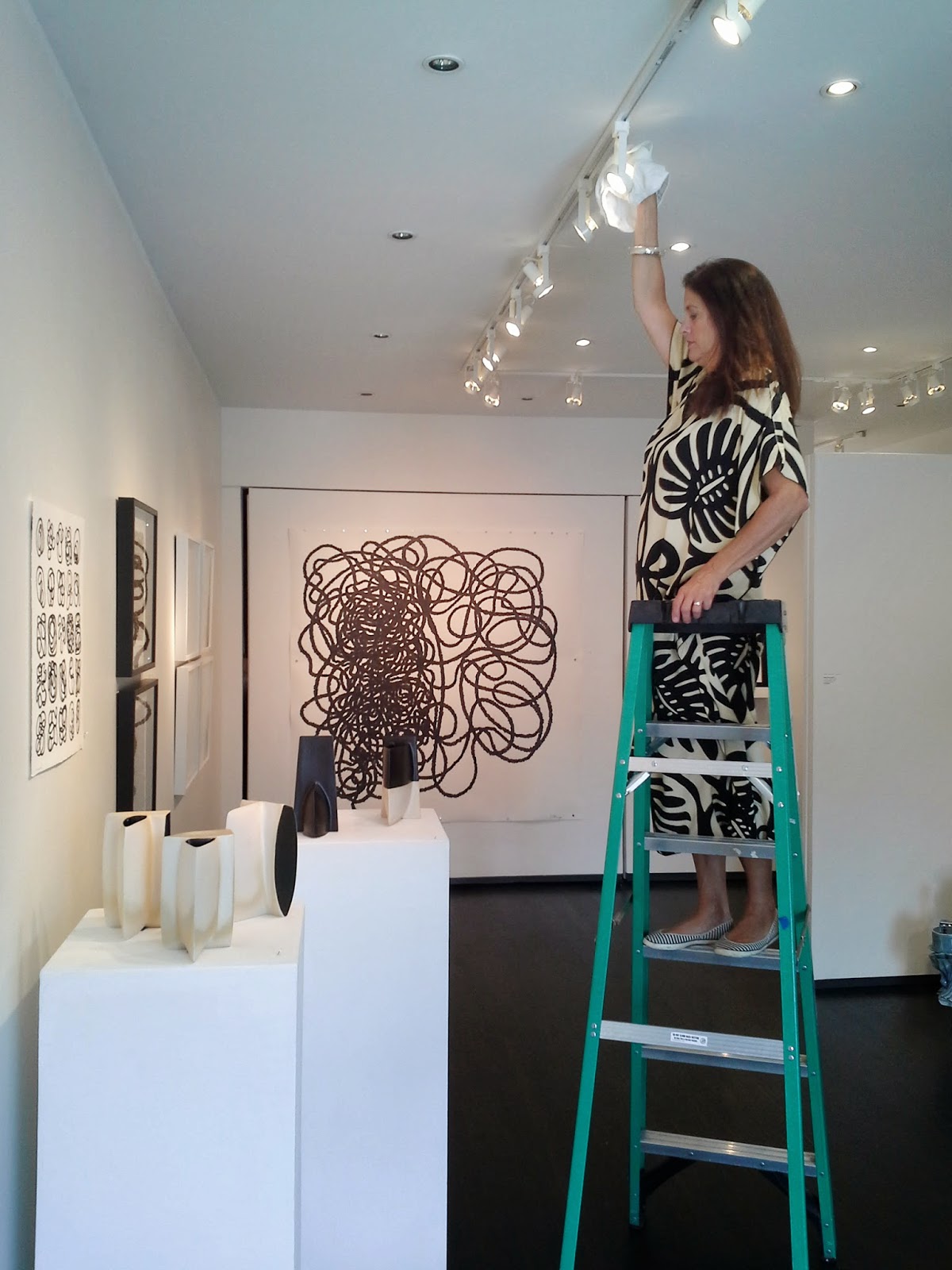 |
| Rebecca Cross, owner of Cross MacKenzie Gallery, makes final lighting adjustment on Lyn Horton's work. |
 |
| Lyn Horton drawings: l: Three line characters, 2014; r: Strands, 2010. |
 |
| Lyn Horton drawings: l to r: Silver & Black, Gold & Black, Black & Silver, Black & Gold, 2014. |
 |
| Lyn Horton drawings: l to r: 25 Characters, 2014; (upper) Gold & Silver, (below) Silver & Gold, 2014; Maren Kloppmann ceramics: on pedestals. |
 |
| Lyn Horton: 70" Square Drawing Black & White, 2014. |
 |
| Lyn Horton drawings: l: 70" Square Drawing Black & White; r: White Characters, 2014. |
 |
| Lyn Horton drawings: 3 Sequential Series White & Black on Green & Rose 1-4, 2014. |
 |
| Lyn Horton drawings: l: (upper) Silver & Gold; (lower) Gold & Silver, 2014; r: Single Loopy Line, 7, 5, 3, 8, 2014. |
 |
| Lyn Horton drawings: 9 White Characters, 2014. |
 |
| Enlarged Photo by Richard Laurie of Lyn Horton standing in front of one of her wall drawing installations in the window of Cross MacKenzie Gallery. |

Tuesday, September 2, 2014
Matthew Shipp: I’ve Been To Many Places, Thirsty Ear, 2014

Since Matthew Shipp has known the piano, the way he plays it
has inevitably changed. Not that he has refuted traditional methods or those derived
from musicians who have influenced him; rather he has used all these methods as
a means to break musical language barriers in order to merge with his intentionally
vast expansion of the piano’s sound, so vast that he reaches into an unknown personal
space and time.
In his solo release, I’ve
Been To Many Places, Shipp looks retrospectively at several pieces he has already
recorded and filters them through the way in which his playing has developed. These selections as well as improvised works
constitute the album. Those unfamiliar with Shipp’s music would by nature hear the
recording as all brand new, just as Shipp believes it is himself.
On the whole, the music bears a relaxed, though beautifully
pristine, feel. It isn’t that Shipp has tossed away many of the Shipp-isms
which are recognizable in past recordings or performances. Instead he has simply let go of the tension
and tightness that sometimes informs his signature style.
His journey on the keyboard is fluid, often moderating
between mid-keyboard and treble pitches, not addressing many of the huge, heavy, black
block chords that he is adept at integrating into his expression. The rhythms
are always switching, especially noticeable in the standards, “Summertime” and “Tenderly,”
and identifiable in Shipp’s compositions: for example, in the beboppish “Brain Stem Grammar,”
the elegant “Waltz,” the delicate “Symbolic Access,” the quasi-swinging “Blue
Astral Bodies” or the deeply moving “Life Cycle.”
Dissonance is often crucial to the musical discussion as is
repetition, giving way to abstraction, the deconstruction of some tunes and the
construction of others. Coltrane’s “Naima”
and Walter Gross’ “Tenderly” are hardly recognizable due to Shipp’s shift in emphasis
on the phrasing of what we are accustomed to hearing. Most surprising is the
pianist’s rendition of Donny Hathaway’s “Where is The Love?” and its rhythmically
dilated reprise after the steadied, clutching, chordal “Light Years.” The insertion of “Where is
The Love?” is surprising because Shipp throws in an aspect of “the popular,” not
only for the reason that it reflects his recording experience, but also because
it is a downright cool thing to do. Shipp is human, after all. And very cool.
Shipp is a master of the piano. He will never let anyone
forget it. And he will embrace every chance to make it known by surrounding his
audiences with unusual approaches to the keyboard every time he plays. He knows
that the universe is everything; that we are only atoms; and that sound is the never-ending
expedition of the wave. The twenty-three seconds of resonance coming from the
last chord of the concluding “Cosmic Wave” proves it.
Copyright 2014 Lyn Horton
Track Listing: I’ve Been To Many Places; Summertime; Brain
Stem Grammar; Pre-Formal; Web Play; Tenderly; Life Cycle; Brain Shatter;
Symbolic Acces; Waltz; Reflex; Naima; Where Is The Love; Light Years; Where Is
The Love (reprise); Blue Astral Bodies; Cosmic Wave.
Personnel: Matthew Shipp: piano.
This music review will be
the last one that I will be writing. Since 1995, I have written well over five
hundred articles about the art of music and its musicians. I have attended many
concerts, listened to many recordings and have advanced my education in ways I
would have never predicted prior to my engagement with the music. I know many
musicians personally and love them all. Thanks to the musicians who have given
to me freely and spiritually. And thanks to the record companies who have
allowed me to open my ears with their recordings.
Friday, April 18, 2014
Fay Victor Ensemble: Absinthe & Vermouth, 2013: Greene Ave. Music

A voice can do something that no other musical instrument
seemingly can really do. By its very inflection combined with its wide-ranging tonality, Fay
Victor can evoke emotional and attitudinal responses and mold an atmosphere
that rings of an ever-changing context. Because she is aware of a spectrum of music to include Arnold Schoenberg, who is said arguably to have changed 20th
century music for rest of time; and because she has inhabited Europe,
specifically Amsterdam; and because she has, for many years, composed with her
Netherlander husband, Jochem Van Dijk; and because she is a rare autodidact,
when she sings, she is singing outside of her mature self. She is radiating into the
world her passion, intelligence and a sensibility to the absurd.
The Fay Victor Ensemble, or FVE, has made a mark on the viability
of the small musical group genre beginning with its first album, The Freesong Suite, released in 2009. (From Fay Victor's website: The Freesong Suite was the only all original vocal project to be voted the 2009 Village Voice Jazz Critic's Poll Best Jazz Vocal.) Suite is a beautifully consistent and fluid recording where Victor’s
versatile voice establishes itself as a force as strong as the instruments
which play along with her. Her group here is made up of truly solid musicians:
Ken Filiano on bass; Anders Nilsson on electric guitar; and Michael “TA”
Thompson on drums. In Suite, Victor and Van Dijk have
constructed a piece of music that bears the textures of a work larger than
expected for a quartet to produce. The music reveals light and dark, the soft and hard,
the busy and calm, the expressive and quiet within a complete framework where
no interruptions, only transitions, occur. The musical instruments create the
environment where Victor can float freely, understandably, interacting with this
experimentally alive composition.
The same is true of the 2013 release, Absinthe & Vermouth. Clearly a toast to the turn of twentieth
century Europe in the strangeness of lyric and sometimes in the phrasing of the
music, this recording possesses an inimitable fascination with the variations
of sounds and how well they work with or are contrary to the main verbal content.
The music comes from a trio: vocalist Victor,
guitarist Nilsson and bassist Filiano. There is no drummer.

Aspects of rock are reflected in some of Nilsson’s guitar
licks. Aspects of blues and jazz are heard in quick rhythmic components from
all members of the trio. Aspects of classical are heard in Filiano’s virtuoso bass playing. Aspects of synthesized and live non-electronic music are interwoven into
Nilsson’s sculpted electric guitar lines. And aspects of broadway-style and folk song stories
come through the patently stellar vocalizations of Victor. Created is an album that
is more than unique. It challenges the ear with its brashness and subtlety, coolness and fire.
Victor alone takes tone for a walk along a graph line of
high pitches, painfully well-enunciated spoken words, dissonance that lurks in
the shadows of Pierrot Lunaire, impulsive swooping crescendos and cabaret-like
songs. Her lyrics are extraordinarily basic, clipped and unromantic.
Absinthe & Vermouth
is just that: a mix of the bitter and the sweet in a well of
contrasts that ensues in the dynamic that naturally emanates between opposites.
Personnel
Fay Victor: composer and vocals;
Anders Nilsson: electric guitar, vocals;
Ken Filiano: double bass, vocals.
Tracks
Big Bag; Crystal; I'm On A Mission/Paper Clip; Gunk; Robot Clown; Seashore; Talk Talk; The Sign At the Door; Shaded in Grey.
Subscribe to:
Posts (Atom)
Is the Picture Big Enough?
Life poses many choices. I gotta pick something every now and again. Hopefully, the choice I make is the best one for the moment. But, how ...

-
 Life poses many choices. I gotta pick something every now and again. Hopefully, the choice I make is the best one for the moment. But, how ...
 -
 Too often, one can plow through life believing, or not even believing, rather mindlessly thinking that being here, alive on earth, is a mat...
 -
 Viewers must be visually cautious in approaching the art, no matter in what form, of Sol LeWitt as if it were for the first time, without ...