Friday, June 22, 2018

As Seen On ARTEIDOLIA: Taryn Simon's Temptation


Taryn Simon’s Temptation


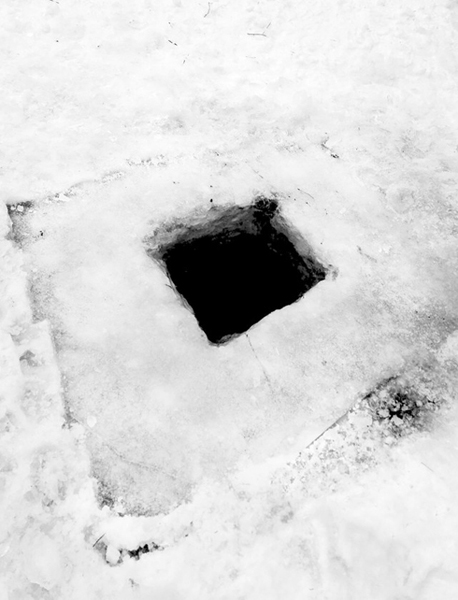
A Cold Hole, Courtesy the artist, MASS MoCA, and Matti Koivula


On March 26, 2018, MASSMoCA celebrated its summer season at an opening of two installations and bookwork of artist, Taryn Simon. The works fill nearly the entire first floor of the museum.

One installation piece is called A Cold Hole, as shown in the first photo at a different venue. The installation at MASSMoCA is the subject of this article.

This work requires actual participation to be realized for what it is. At the opening, three persons took part. The action is to drop into a pool of ice-cold salt water the opening of which is eight-foot square. The fifteen-foot-deep tank of water is imbedded in a large white room whose floor is packed with rough hewn ice and whose temperature is kept cold enough so that the ice does not melt.

The audience for this event views the participant through perhaps a nine by fifteen-foot movie screen-proportioned window whose bottom edge is about sixty inches off the floor.  The window is carved out of a wall in a room that is totally black, the reverse aesthetic of the room where the pool is located.

I witnessed a young woman, a young man and the Director of the museum drop into the hole.

The young woman wore only a white t-shirt and her black underwear. Her hair was also black. She was of Asian descent. I did not count the minutes she stood in front of the hole. But she stared straight ahead for quite a while, her arms aligned with her body. She shook her hands to relax her arms and shoulders as if she were preparing to mount a starting block from which she would dive for a swimming race. Her eyes and head were directed towards the space in front of her; she talked to herself a bit and then did not move.

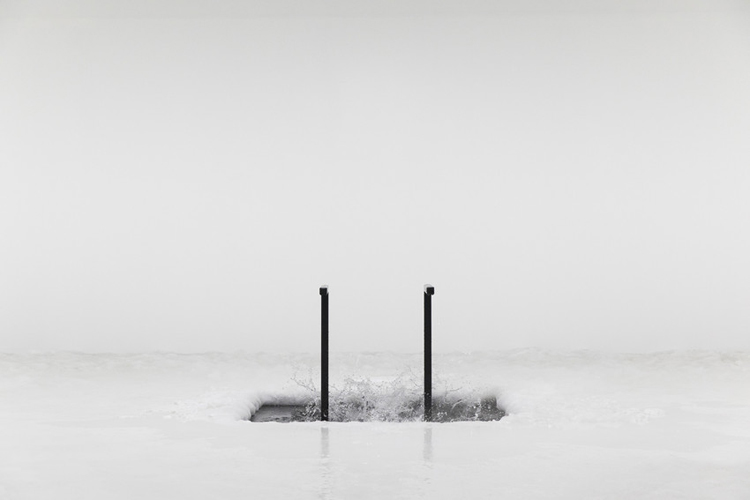
Taryn Simon, A Cold Hole, 2018, As installed in Taryn Simon: A Cold Hole | Assembled Audience
(MASS MoCA, North Adams, MA, on view May 26, 2018), Courtesy Taryn Simon Projects, Photo: Jack Criddle


In an unpredictable moment, she simply fell into the hole in front of her, disappearing for seconds until her head bobbed up and was visible between the rails of the ladder mounted on the far side of the hole. Her mouth was open, she moved her hair back from her face with her right hand as she climbed out of the hole. She walked forward to the window, turned left and vanished from view.

The second person to ‘take the plunge’ seemed far more easy-going. He was older than the woman who preceded him.  He wore no shirt and only a pair of belted shorts. He was heftier than the young woman, who was tiny, actually, in comparison. He stood for a short period of time in front of the hole, his head tilted, chin to his chest, as he stared into the pool. And in an instant, he, too, disappeared into the water. His exit was substantial and affirmative.

It was surprising to discover that the Director of MASSMoCA, Joe Thompson, participated in this piece, but, in reflection, it makes perfect sense. Of course, he would. He is the ultimate participant in everything at the museum.

I saw Joe enter the cold room from the hall walking on a black metal slotted pathway leading from another room. His focus was palpable. A herd of people, including me, rushed into the area for watching his descent into the water.

There was Joe, visible right behind the window looking at his watch before he marched to the hole. He was wearing a suit and tie and shoes. When he took his place behind the hole, he looked at his watch again. He removed his glasses and tucked them into his jacket’s chest pocket; he tapped the pocket to secure them.
He folded his arms across his chest and heart, palms down, in a position of submission. Within less than thirty seconds, he was in the water. And then out. Fully standing in front of the railing, he put his glasses on and walked straight towards the window, peered through, made no gestures, turned left and disappeared behind the black wall.

Stunned, I stayed there in the darkness looking through the window, vicariously imagining what it felt like to do what these people had done. It was like an episode in a production of a living theater piece.

Two people suggested that I participate in this event. I mulled that idea over for a couple of days. I found the internet address where I could make an appointment. Two were available.  I stared at the screen of my tablet before I filled in the requested information. But I shied away from clicking the ‘submit’ button. Later on, that same Sunday, I went back to the appointment page. The time I originally wanted was taken. I distracted myself again from making an appointment. A few hours later, I returned to the appointment page; only one time slot remained. I filled in information again about myself and clicked the submit button. 

I had followed through. Two weeks in advance.

During those two weeks, I tried to determine what entering the saltwater pool would be like, based on what I had witnessed. The thought of it intercepted my routine thoughts periodically. I even practiced turning the shower knob quickly all the way to cold, after bathing in warm water, and standing from my neck down in streaming cold water for ten seconds. Every time, my system would be shocked by the sudden change in temperature and I would groan, but, by the count of five, my body was accustomed to the cold.

I even believed that continuing to read Walk Through Walls, Marina Abramović’s autobiography, would help me to understand how to muster the strength to withstand physically and emotionally an unusually dramatic circumstance.

The Friday before I was to go to MASSMoCA, I exercised on my stationary bike for a normal twenty minutes, the equivalent of three miles. This provided me with enough serotonin to avert the anxiety of the upcoming event. I followed my normal day in my studio.

Saturday, June 9, at 12:30 pm. My appointment at A Cold Hole.

I lay in bed awake at 7:30 am, finally pulling back the covers to leave the bed and sit on the floor to meditate for nearly forty minutes.

I went downstairs to have breakfast. It occurred to me to postpone regular house cleaning activities because I had to leave by 11:15 am in order to be at the museum a little early. Postponing cleaning was useless. It was all I could do to thwart the anxiety that was building. Music streamed off the Internet on a 24-hour jazz station out of Washington state.

After my morning routine was finished, I skedaddled out of the house, remembering to feed the cat before going through the door to the car. I decided not to eat anything.

I stopped at the Post Office on the way out of town.

It was a beautiful day. The drive to the museum was really quite peaceful until I reached Adams even though the traffic was not bad for a weekend. I arrived at the museum, parked, and grabbed my bag, containing the clothes I was to wear as per instructions of the team of people handling the event; locked the car; and walked through the parking lot to the museum lobby.  One of the receptionists at the entrance directed me to the man at the information booth, who directed me again through the doors to the first-floor gallery where the Simon exhibition is installed. I did not have to show my membership card to gain entrance to the museum.

Standing in front of a door to the right as I walked into the galleries were two women, carrying clipboards of attached lists of scheduled participants. I checked in and was asked to wait for ten minutes before conferring with them.

I saw a girl walk down the wire footpath from what must have been a dressing room to the cold room. I went quickly to the viewing room to watch her drop into the water. She was clothed in a long white diaphanous dress. Her hair was blond and cut close to her head. She appeared a wash of consistent pale color.
She stood calmly behind the hole, her arms at her side. She looked up at the ceiling and circled her head to gaze around the large room. Her physical presence did not interrupt the whiteness of the environment.

Finally, she looked down at the hole, not taking much time before she dipped headlong into the water. Her face appeared above the level of the ice floor quickly. As she rose, her dress was clinging to her small body. Her nakedness had been revealed. She walked to the window, picked up the skirt of her dress slightly with her left hand, signaling a bit of embarrassment; turned left and was gone.

I swallowed hard knowing that I was next.

I walked back to the dressing room entrance and waited for her to exit. When she did, two girlfriends chattered at her and then enquired as to how she felt: “Are you cold?” one friend asked to which she replied: “No.” She was unrattled.

One of the event’s managers called me into the dressing room. I turned to follow her inside. I sat down. With a soothing demeanor, she handed me a couple of disclaimers to sign, including one which described the risks of what I was about to do. I read it carefully. The words described drastic possible scenarios, including death. I had to confirm that I was over eighteen and healthy and could swim. As I signed my name on the form, I said out loud: “I can’t believe I am doing this.” The woman who was speaking to me said: “Take your time.”

She described in detail how I was to enter the water, complete with illustrations. And then she said: “Will you show me the clothes you plan to wear?” I pulled a pair of black leggings and a white exercise top out of my bag. She wanted to be sure that I was not going to wear my ‘street’ clothes in the water. Then she directed me to choose, from a selection of differently sized black foot pads, a pair to wear on the bottoms of my bare feet so I would not slip on the ice. The two women left the dressing room, shut the door, allowing me to change clothes. I did so. I had trouble peeling the backing off the adhesive non-skid foot pads and mounting them to my feet because, one, I was nervous, and, two, I did not have my glasses on. They were in the car.

On the outside, I was ready to go. But internally, I harbored deep trepidation and, paradoxically, wonder.

I took a breath, opened the door to the black walkway, walked to the heavy black tinted door, opened it, crossed the threshold and there I stood, next to a seated female EMT, facing the ice floor.

When I stepped onto the ice, lightheadedness seized my body from my head to my toes. My steps along the path I was told to walk were careful and slow. The ice was rough and had small peaks and valleys I had to negotiate to maintain my balance.
I reached the back edge of the hole and stopped, turned, faced forward and stayed. My hands touched my thighs. My longer than shoulder-length hair brushed across my cheeks as I looked down into the cavity that was the tank that held the water. I could see the ladder.

The surface of the water seemed thick like oil. The steady ripples in one thin horizontal line close the back edge of the opening caught the light from above. The two square-shaped skylights were reflected on the surface; the lights were the only means to discern the shine of the metal ladder through the pit of blackness between me and the other side of the hole.

I had read none of the artist’s words mapping out her intentions behind the design of  A Cold Hole or explanations why she chose to borrow it from other cultures and magnify its existence in this installation.

This quickly became my own uneducated singular experience.

As I looked into what can be characterized as an abyss, a source of mystery and a path to the unknown, I meditated. The room hummed. The whiteness surrounding me expanded like a balloon. The cold embraced me as would warmth because it was outside of the hole, the place I was to go before leaving the room. I had committed myself to taking that literal step, although I could have backed off at any time. There was a vast distance between stepping into the water and not. That distance was purely psychological.

The hole tempted me to go in but at the same time repelled me. It tempted me for the reason that I was curious about the water once sunk into it. It repelled me for the reason that as I stood there, every fear of every trauma I have ever suffered paraded through my meditative state. I was totally present with my fears. I was totally present within myself.  The hole and I were the only two elements that existed in that moment, exclusive of anything and anyone else. Going into the hole meant transcending the stupefying trepidation laid bare in one short twelve inches between me and it.

I crossed my hands over my chest as Joe had done. I had been inhaling and exhaling methodically since I had taken my place. My heart was beating so fast that I took time to try to slow it down biorhythmically in my meditation. As I attended to that process though, the pace only increased. I did not know what to do.

The idea that my balking would cause the EMT to retrieve me crossed my mind. I decided that I would succeed. Failure was not an option.

A foam pad was placed on the very edge of the hole. I stepped onto it. The cold of the room intensified.  My legs started to shiver. I was overwhelmed. I bent my knees slightly to relax my legs.  A kind of other awareness told me to do that.

I knew that I was about to go into water. I still could not understand how I would get there. And, then, something happened. A clarity of nothingness pervaded my entire being; I moved my right foot forward, the other followed; I moaned loudly and I was in the water. My body had entered straight, I thought. When I opened my eyes, I was on the left side of the tank; my limbs felt like they were detaching from my trunk. They flailed around until I saw the metal ladder. My left hand found the left rail. I pulled myself around so that both hands were engaged in exiting the hole. I felt one step with my left foot and then began to ascend but missed a step with my right foot. I pulled it off the ladder and found the correct step to push on. I kept on going instinctually until I was out of the water and standing on the ice. I never noticed how cold the water was.

My connection with the upper world resumed just as I started walking towards the window, which was a very slow-moving journey. When I reached the window, a number of people who had been watching me began to clap loudly. I could only see one woman clearly through the glass looking directly at me. The rest were merely hazy silhouettes. I smiled.

I turned left and stepped towards the exit where the EMT was still sitting. I stopped and said: “That was the hardest thing I have ever done.” She said: “I know. You were standing there for fifteen minutes.”

The amount of time that had passed seemed to me to be merely a couple of seconds. I had reached Nirvana. The power of Nirvana had ushered me into the water in the hole.

No preparation for this exceedingly private experience is possible.

Only being swallowed by the water for the first time is.


Taryn Simon, A Cold Hole, 2018, As installed in Taryn Simon: A Cold Hole | Assembled Audience(MASS MoCA, North Adams, MA, on view May 26, 2018), Courtesy Taryn Simon Projects


Sunday, February 11, 2018

I am an Artist


It is Sunday.
It is raining.
The radio bellows out a Brahms piano concerto from a past concert from the BSO.
My son is running for twelve hours to celebrate four years of sobriety. He started in the dark. He was wearing a headlamp as was shown in a brief video documenting his checking his on-body gear.

Yesterday someone said to me on the phone: Well, you’re different.
In relation to what? I should have asked.

Society? Community? Animals, plants?

In therapy a couple of weeks ago, I explained leaving a meeting that was convened to assess the upcoming studio tour in the summer to which I had been invited. During the description, I started to heave with laughter on the verge of hysteria as I let loose on how I was expected to contribute to the group participating in the studio tour beyond simply opening my doors to the public.

The latter conversation connected with many others that my therapist and I have had about how difficult it is for me to get along with people.

The conclusive bridge in the session was that I am highly individuated. This has occurred over time so that I can protect myself from criticism and injury. Criticism of how I am carrying on with my life and injury from those who could harm me emotionally.

Making art has been the key to tapping the breadth of my creative mind. The one where peace and ease and imperfection can comingle without being questioned except by me. The one where the tools blend with purpose. The one where many avenues can be traveled at once. The one where interruption from external sources is annoying. The one where I can devise my next moves in the studio. The one where I can propel myself with veggie smoothies and chocolate bars. The one where I ingest more than food from the streaming stories I choose on the Internet. The one where my eyes and ears are key to my existence.

The places I can go in my work I cannot see until I go there. My ideas unfold as in an improvised monologue. A solo performance ridden with history: my life history, art history, psychological history, mnemonic history, science history, environmental history. History.

This evaluation was contained in other words in a syllabus for a drawing class I taught at CalArts, when I was a Teaching Assistant, at age 24.

I am the same person now as I was then only I have changed. Can you tell?

I long for unity everyday with the universe in meditation and in how I contribute. I was reading this morning how important it is to realize that I matter.

Matter? How do I matter?
Because you are reading this? Because I posted on Facebook and Twitter this morning? Because I have an Instagram account?

Does the way I filter the world and express it to you brighten your world? Does it help you move through your life?

The substance of this bit of writing will be shared by few. But will the energy I have expended to write how I know at this moment charge the air to put it in more balance only to fall out again in the smallest increment of time?

When I first went to art school, I used to sit with a typewriter on my lap typing reams and reams of paper with very little on each page. Together in a sequential pile lay the meaning of my efforts. A documentation of the passage of time. A reflection of my training in art by one of the founders of conceptual art, rarely noted in the history of it, Douglas Huebler, and his fellow professor, Donald Burgy, a practitioner of viewing and noting his views.

I still enjoy this typing ethic. In fact, I never learned how to type. I am always making mistakes which you cannot see unless I miss correcting them. When I was a little girl, I used to sit at a metal table and imitate my grandfather’s secretary by tapping on the table to make the sound of typing. Me in my little pink skirt outfit, short white ankle socks with the tops folded down and Mary Jane shoes.

At least since growing up, I have understood that the nature of the tapping is related to words which can offer some meaning or not. On the other hand, I could sit here tapping to revel in it or actually document it as a piece of conceptual art. There is always more room for it.

The Brahms concert on the radio has finished.
The sky light is still gray.
It is raining.
It is February 11.
My son is running.
I am an artist.


copyright 2018 Lyn Horton


Friday, October 13, 2017

As Seen on ARTEIDOLIA: Article on Nick Cave Artist

More Than Seven Steps

Lyn Horton
October 2017


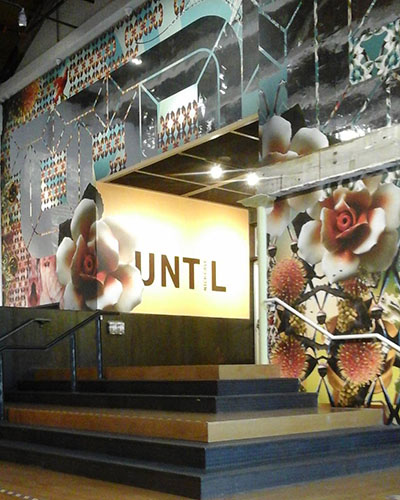
Nick Cave Takes More than Seven Steps to Heaven in "Until"


Nick Cave’s spectacular installation, Until, at MassMoCA in North Adams, MA, closed on Labor Day of 2017. That day was the last day to see it. Experience it, ingest it later to digest it and incorporate it into one’s soul. The fallacy of attempting to do so in only a day prevails when one is struck by its awesome presence. No one just catches “the Cave.”

Being with Cave’s work for days on end is the only means to grasp its intensity, roll around in its embrace, recognize and hopefully comprehend its message. Its message in the title of it, Until, strikes a prepositional chord of the “in between-ness” which all its parts suggest. The parts are so dynamic beyond their appearance that their object nature is transcended. It is the artist’s intention with this never-ending agglomeration of statements, confined only by the walls of the museum building, to establish constant metaphorical motion, constant mental engagement in questioning, wondering, coming to conclusions, dashing the conclusions, while remaining in a state of astonishment.

The content of the entire exhibit took three years to make. The pieces within the installation’s entirety use so much physical material that the weight of it and the contrasting uplifting character of it are immediately felt. To absorb the information that begins to unfold as the percipient walks through the doors of the football-field-size exhibit hall is a test of stamina and attention to the overall environment as well as to the detail within it.
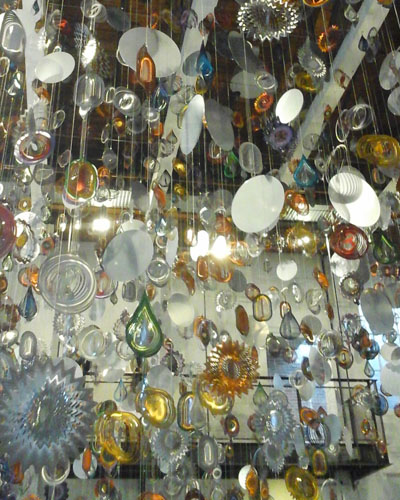
First, one is met by what could be designated several ways, as rain, as twinkling stars, as strings of mirrors, as Christmas decorations. The colors of the hundreds of metallic spinners, rotating in a sporadic yet uniform twirling motion, fall from the ceiling, which really feels more like the sky. For a child, the forest of spinners must seem immense; for an adult, the same, but not as immense.

The circular or tear drop shaped spinners, even though repeated in striated form and spaced equally along the lines that suspend them, are stories within themselves when studied. Despite their beauty, they are portraits of violence, explosions, and whirl winds of terror. En masse, their movement depicts pirouettes being done by hundreds of metal miniature dancers. The hazily reflecting solid circular shaped discs remind the viewers that they are a part of that which has been presented. Reflective tiles are also laid out on the floors beneath the spinners. To stand on these tiles means seeing oneself. Audience inclusion is integrated into every aspect of the journey.

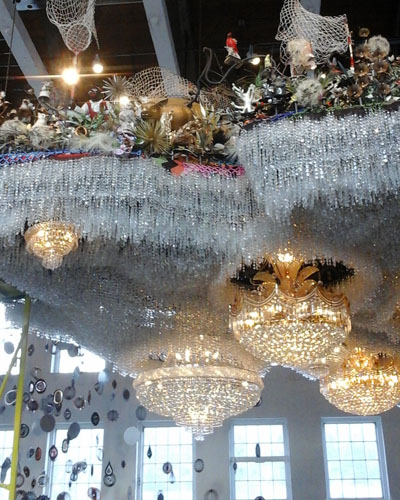
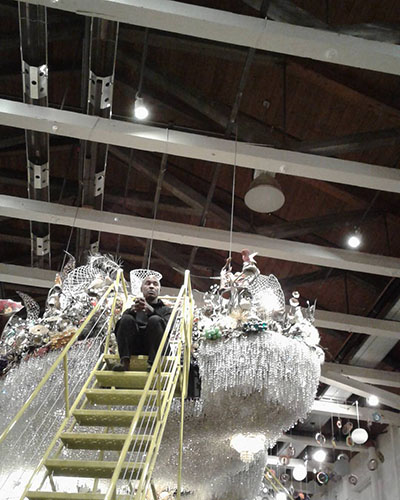
A pathway winds through this fantastical world and eventually ends underneath a cloud of the best examples of Empire crystal chandeliers. They visually support the centerpiece of the installation which is a construction of Heaven, suspended from the ceiling, reachable on each of four sides by fifteen-step staircases on wheels. The rest of the cloud visible from the floor is filled in with pendulant vertical crystals, creating a delicate, misty and total surrounding. One can detect hints of what is growing upwards from the clouds by standing and looking up before one mounts a staircase.
A multi-colored web of beads seems to hold the array of the constituents of heaven. Hundreds of lawn ornaments, including and most prominently, lawn jockeys, are arranged across the beaded–web box spring that supports them. Flowers with mirrored centers, birds, fruits, snakes, frogs, fake dandelion blooms, an alligator, cornucopia- shaped Victrola speaker horns and dream catchers, formed like the speakers and butterfly nets, are interwoven in this dense display of elements. That these frozen solid motionless elements are juxtaposed magnifies the intensity of the meaning of their coexistence, not only up there in a metaphorical heaven but also in a real world down below.

To photograph that which is atop the clouds is to record only a memory of their visual impact. Up there is the core meaning of Until. The viewer’s inclusion in the above-the-cloud space renders him or her part of the communication of the nature of racism. The speakers shaped like megaphones are broadcasting the inaudible sound of the persistence of racism’s existence. Hear me! Hear how false racism is! shout the lawn jockeys, cheerfully black-faced, guarding manufactured nature. Just as everything collected and arranged here represents an assemblage of the ‘real fake,’ so is suggested that the practice of racism is false and, therefore, taken further, intolerable.

The dominating question raised by Cave…‘Is there racism in heaven?’… is unanswerable here on earth. In this landscape, Cave has structured the question as he structured the sky, rain, clouds, the mountains and the trees in his own artistic language. The question is answered through one’s actions, the evocation of one’s passion to bring light to the darkness of a societal disease that penetrates the world, and is not only exacerbated and made proximate by the inexcusable actions that take place in America.

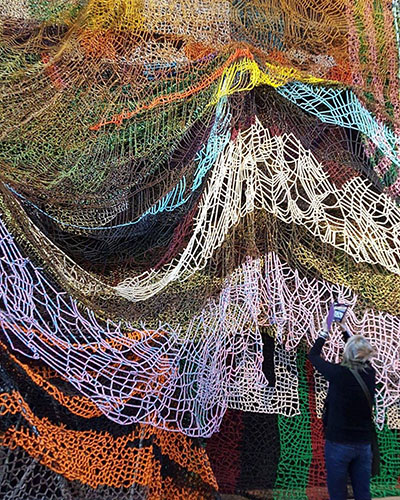
Beyond Heaven on the cement pool of the huge gallery floor continues a mountain range, made of beaded webbing, strung to the height of the loft that is the partial second floor of the space. On the face of the mountains are beaded in graffiti-like formations, a peace sign, a rainbow and multiple signs whose origins are positively ethnic.
In a smaller room, whose entrance opens up beside the mountains, to a hall plastered with a repeated yellow, black and red image, is shown a video based on the idea of escaping the stereotype of the black man.

A cookie cutter version of a black-face man is stuck in a container in the center of the room midst raffia, unable to get out, slammed against the glass, prevented from coming alive.

In a stroboscopic projection on the four walls of the room, the figure becomes alive. The film motion loops more in patterns than literal depiction of the figure. Its turning point is the visible struggle for Cave’s eye to reach an eyehole of a costume mask to peer out. When he reaches the opening, he is looking at you. This image will remain with you forever.

Upstairs from that small gallery, a second floor houses a huge wall of fans blowing glittering Soundsuit material. When the viewer stands back far enough, the word “FLOW” can be discerned. The relation of this piece with the remaining work that establishes the whole of Until renders the prepositional aspect of “until” active. In other words, where one action could stop “until” another action could occur, the idea of the “flow” of one action into another supersedes a cause and effect succession of actions. The fans blow away the stopping of reaction. Flow is unstoppable conceptually. Flow blows right over the five blocks of an incomplete picket fence that stands before it on the floor. Nor does flow stop the bird that unpredictably flew through a window on the last day of the installation at the museum; flow invites that occurrence.  The window hangs on the wall as one exits to go back down stairs.
The ultimate calling for this exhibit for Cave was the collaboration that was required to build it and bring attention to it. Throughout its nearly yearlong stay at MassMoCa, Cave invited dancers, writers, poets and musicians to respond and periodically perform in their own way to his own art.

The last performance was “The Culminating Performance.” It happened three days before the exhibit ended. Those attending sat under the clouds.

Poets recited their telling words and vocalists sang their glorious gospel-like songs. Cave formally closed the event by donning a specially designed Soundsuit. (Cave is the inventor of the “Soundsuit,” a costume worn by dancers or performers, and placed in sculptures.) As is every Soundsuit, this one was constructed of more than several parts, each made of specially-picked materials. Each part was given by Cave’s designer and partner, Bob Faust, to those in the audience without whom the exhibit would have not been possible. Each of those persons was gestured by Mr. Faust to clothe the artist, one part at a time. Cave sat, erect, directed away from the audience, on a yellow chair in front of the choir, vocalists, drummer and organist, ready to receive the parts of the Soundsuit, to be dressed for a final formal good-bye.

Once the Soundsuit completely covered Nick Cave, he rose. The suit was heavy. But his heart, mind and body were strong. He danced, for he is a dancer; he bowed to and held the hands of each person whom he wanted to thank, then skipped away past the beaded mountains and disappeared.

Although deeply emotional and tearful, the ceremony was joyous. For Nick Cave had sent his message. He had opened hearts and minds to the beauty of humanity, despite its inherently drastic imperfections.

Art is powerful enough to surmount stark, divisive differences, you know. And Nick Cave proved it.


all images courtesy of Lyn Horton

Friday, May 26, 2017

What I Thought I Knew


Since last September, my life has thrown me one punch after another.


The savior, which blocked the punches or made them not hurt as much, is my work.


My intentions for doing and for which I have been punched have all been greater than how they were received.


If I have dreamed of some glistening ideal, none of those dreams have even shown me a glimmer of spidery-webby gossamer.


Faith? Well, how does it work?


Do you know how many times I have thought of ending it all within the last months? For one simple reason: to extricate myself from problems that have no solution. From the burdens I carry for which there is no service, no person, including myself, to free me. Where do people go when the confusion is so dense that seemingly no exit appears?


The wonder that is my work disappears as I am making it for I am always remembering that something else to do is coming next. And how will I ever get there?


Finishing, finishing, finishing. Ensuring that the perfection of any piece is not that perfect. Imperfect. Slightly off. Peculiarly human. This woman human drew those lines. Painted those brush strokes.


Who on earth ever gave artists the idea that perfection is mandatory? Why was that a lesson? Guess it had to be back when painting was executed on panels with quick-drying egg tempera or oil paint. I mean we gotta think about Memling and da Vinci and those countless artists whose works line the Renaissance Galleries in the National Gallery of Art in Washington, DC.


So given that imperfection is acceptable, why do I think often that it is not?


Because I hear these voices coming from someone standing behind me that I am making art that no one will like, that no one will pay any attention to because it doesn’t measure up to what that male artist did, the one who is financially successful and can coast through the rest of his life without a care in the world.


I do the work as I see fit anyway. In the afternoon. I drink my power smoothie that leaves green gunk in the glass when I am done and following that I eat an entire chocolate bar, one of the kind that has an image of one of the endangered species on the label.


While doing the art, my mind swims in another state. Sometimes, my body responds to how difficult reaching up to the top of large drawings is. Stand on a stool, silly; no? Ok, go ahead, make it hard on yourself. You are almost done with this section anyway.


Sure this blog writing resembles a personal piece that should be recorded in a journal. But my purple, lined page journal is filled with meaningless chatter; if you call “I AM UNHAPPY,” meaningless. Large letters. The only words on the page.


In a black book, brand new, I have begun to write poetry. “Poetry is the record of the last thought,” as Allen Ginsberg said once in an interview. Oh, so many last thoughts. Oh, so many words evoking the mind of one sad sack. Ridden with exhaustion. Ridden with uncertainty. Ridden with the next thing and then the next and the one thing after that. Which only can be known when the first thing is confronted and seized and done something with.

My struggle is with how do I leave my house of thirty-eight years into which I have poured tens of thousands of dollars and love and grunting. And where I raised my son.


Where is my heart?
Where is my soul?
Reflections. Memories. Bad ones, Great ones. Nonetheless memories.
Of the repercussions of mistakes. Of the hardships of the repercussions of the repercussions.
Of the bitterness. The strain of extruding all the poison from my system.


Where do I need to be? Here? There?
Follow the money?
Find the money?
Follow the people? What people?
Just be a goddamn mensch.
Open the opportunity doors.
I have.


Are these words revealing more than they need to? Are they revealing secrets no one else needs to know?


The jostling of thoughts to form into words here requires a kind of energy that jettisons in a direction that is unlike any other.


Even though it seems I am baring my soul for the moment; really I have launched into an effort to relieve my anxieties. Anxiousness is a terrible affliction; a melding of the mind and the body that implodes, rattles, tears one apart, and whose amelioration necessitates the imposition of calm, and peace. Floating away from the materiality of doing into a cloud of restfulness and that ol’ standby, The breath.


What I thought I knew years ago was that I would act out my life in the picture that my parents constructed for me. So far, trying to do that has caused nothing but pain because I washed my brain of the idea, realizing that its truth was false. And what remains is the creation of my own life. The miseries associated with that life.


The gardens are beautiful. Wet. Wet. Wet.


Not one time do I go outside and is it delightful. The ticks walk on my body into the house with me.


I retreat to my studio. I retreat to my comfort. Of smoothies and chocolate bars.

I long for my son, I long for a family. I long for the parents I did not have.


This is about art. These words concern where my art comes from. These words are another way to express the golden mean of sanity.


Monday, December 12, 2016

Novo Veritas, My Son and I


Reflection

For the first week of November of 2016, I took a trip to Oregon to be with my son. It had been six years since I had seen him. During that time he had confronted his troubles as an alcoholic, about which I never knew a thing until he told me.

When I first encountered him at the airport, he was standing tall and alive, thankfully beardless, and handsome. I perceived him as only a Mother can view her son. All Mothers who understand that perception know that no words can describe the bond. It is strong; the love that is intertwined with lack of condition and overcomes darkness, the blight of past friction and opens into the light of infinitude.

That week our plans were to go with the flow of how any event would evolve and I relished every moment.

That week also happened to be one of the most active periods to date for his business, Novo Veritas.  He and his business partner, Betsy Hartley, were scheduled to give two presentations and appear on a radio show, with host, Mike Parker, the sports commentator for the Oregon State Beaver Sports Teams.

Both presentations showed the passion that both Spence and Betsy share about their own efforts to transcend the difficulties which have invaded their lives and about which they have developed heightened awareness that becomes keener day by day. The parallels which the two have drawn between the ramifications of alcoholism and of Type 2 diabetes respectively address hurdles that many have to jump in order to arrive at a place for fulfilling their lives.

This means choosing, making decisions, turning hard corners in order to uncover a healthy existence whose potential already exists, but which can blossom given incentive and support.


Novo Veritas Speaks

The groups in which Spence and Betsy talked were strikingly different.

The first presentation I witnessed was held in a small running apparel shop in Corvallis. The audience seated itself casually in a circle facing the two speakers. The situation was intimate. But the exchange between Spence, Betsy and several women in the audience proved powerful. One very delicate, fragile, small woman, who appeared to be weary of her stress, asked one question and then followed up with more. She was seeking guidance to move out of the place in which she seemed to be stuck. She shared only a general picture of herself. Both Spence and Betsy reassured her that moving forward hurts only after the initial steps and the continuation of healing oneself, finding that healthy and peaceful place is a matter of time, effort and will.


Another woman, who, as Betsy was and is, dealing with a weight problem, had just finished her first 5K running race, spoke up with confidence and belief in herself, aware still that she was in her "process" of reaching her goal...a testament to the coaching that Spence and Betsy can and do give individuals. The age of the audience varied but was within the range between thirty and fifty. The only man attending was a trainer with whom Spence and Betsy have both worked; he also contributed some positive ideas.

The concluding words to the audience were: We are here to tell our stories to help you tell yours. This sentence is a deep trigger: it makes me think.


The second presentation was held at The Portland Athletic Club in a far more formal setting. The athletic club is an establishment where members inherit memberships. So the audience was a mix of upper-crust attendees with you-and-me-kinda-people. Spence and Betsy were conscious of their appearance for this particular date, knowing that their message, no matter how essential, might go over well if their appearance blended into expectations of the environment. As an introduction, they showed their video, which is always a tear-jerker for me. Then they each went into more detail with their stories in a more audience specific version. Their primary interest is to create a conversation between them and the audience members. So they request questions, as unfettered and unbounded as possible because listening is a means to shape the next steps for growth. One question that I remember distinctly came from an elderly woman, who looks to be in shape and is really beautiful. The question was this: what if life has been good and one simply wants to determine who he or she is? That Spence and Betsy lay themselves open to these amazingly deep inquiries tests the strength of their beings, for often, the questions they are asked pertain to the kinds of questions they continually ask themselves, both individually and together of each other.


Running is the vehicle for Spencer's and Betsy's recovery from their individual statuses. Running implements their sense of self to develop their strengths, contemplate their weaknesses, hone in on their essential nature. This does not mean that their encouragement is directed towards running only for any of their clients or groups, like athletic teams, with whom they work. It means that they both have a starting point for unleashing their experiences. Spence and Betsy can be key to the raising of one's consciousness.


 Mike Parker, a recovering alcoholic himself, interviewed the two (Nov 3, beginning at 75:00) on The Joe Beaver Show midweek. Mike was thoroughly interested and serious about the effectiveness of Novo Veritas. His questions hit upon aspects of Spence's and Betsy's stories which evoked emotion and demonstrated their willingness to help people and do good. A lot of good.  Mike asked them about where they have been, what they are doing and where they want to go. No sensationalism was involved. Just the facts. It was great.


Hang-Time

Most of the time during the week, Spence and I just did stuff. One day we drove to Eugene so that I could replace my dead running shoes with new ones. Sure beat ordering them on the Internet! The hands-on service was terrific. Everyone in the running world knows Spence. He can talk to anyone about anything.

Driving with Spence involved a certain amount of silence because he thinks a lot. Our talking together acquires a special context because we live so far away from each other. Our lives are diverse, but seem similar in our mutual capacity for focus, accomplishment and fulfillment. We also share kindred emotions and personal psychologies: depression and anxiety. Communication about the latter jumps into our talking threads occasionally.

Toward the end of my trip, we spent an entire afternoon working on a trail he is carving out for himself in one of the many forests which pervade the rich vegetative environment where he lives. As we looked back on our work, Spence said: Hey, we must have gone a quarter of a mile! He dug and I widened and softened the paths; I moved fallen tree parts to act as guides for the direction of the trail. We stopped working at the crest of a hill where we could see mountains. Well, mountains are everywhere in Oregon. Not a strange event! And then we walked calmly back to the car, refreshed, revived, and glowing from our convention with nature.


On another day we traveled to a peak from which could be seen The Sisters in Bend looking east across the state and Mount Jefferson. The wind whipped around us as we walked to the top of the mountain on a less used trail. At the top, satellite dishes and lights  spoiled the atmosphere but are, in this day and age, necessary. The peak was barren. My heart was full. The view reminded me of the landscape that lay outside my studio window at CalArts in Valencia, CA.  I had traced the contours of the mountains on the window glass to make a mock drawing of what would influence the subject of the rest of my art-making life.


At the end of the week, we went to dinner on the nearby coast. It was raining cats and dogs. We floated on our journey as if we were on a boat. It was crazy to have come to the beach when the rain dropped in sheets and my raincoat billowed in the wind. But, hey, I took some pictures to document the fact that I had reached the Pacific Ocean. Dinner was lovely and quiet and full of joy. At no time did I ever think as a Mother that I would be having dinner with my mature thirty-seven year old son in a restaurant by the ocean to which he had driven me for a belated sixty-sixth birthday celebration. Age means nothing. We both know we are still growing up.


The Part Called the Ending

Telling this story touches on the reasons I have such immense pride in how Spence has stepped into the hole that is his disease and is climbing out of it to re-create the positive path that is his life.

Every photograph I took of him or of the landscape mirrors his history. Every word he uttered informed me of all the remarkable places he has been in his mind and body and all the unimaginable, unknowable destinations he will choose to travel to for himself.

My son stands out boldly against the bright clouded slate blue Oregon sky. He meets, as do I, uncertainty every day. Every day, however, with unanswered questions swimming around in his mind, he does not relent in pursuit of the next question. He leaves the questions he has remaining unanswered until the necessity for questions and answers disappear into the folds of what he has named the 'process' of living. His life will be long.


Is the Picture Big Enough?

Life poses many choices. I gotta pick something every now and again. Hopefully, the choice I make is the best one for the moment. But, how ...